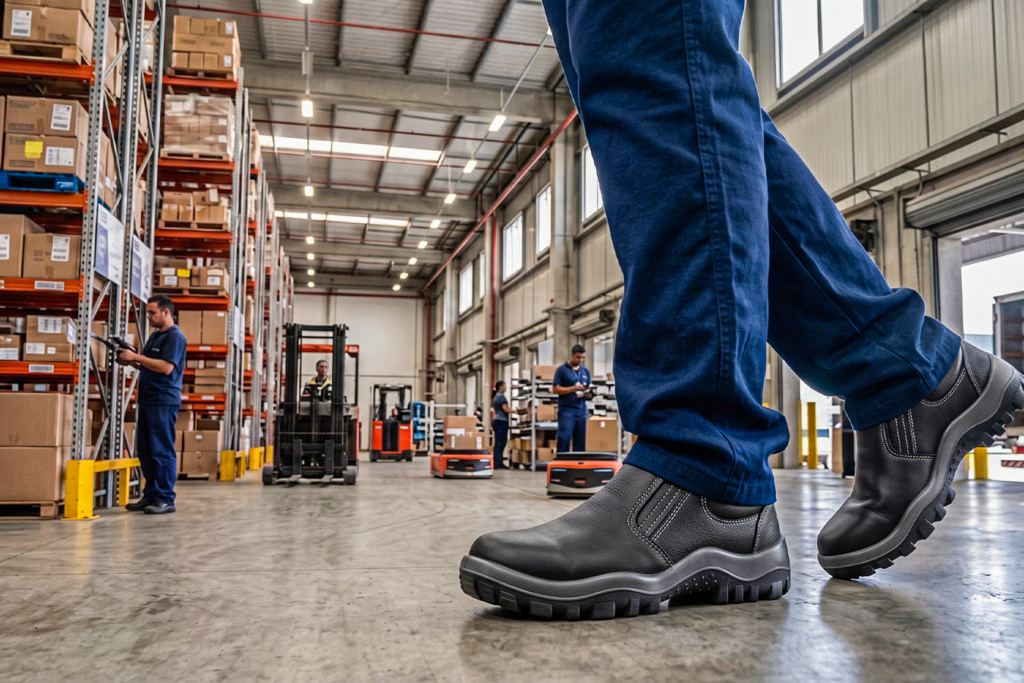

Safety footwear for logistics protects the feet of workers in warehouses, loading docks, and distribution centers. It combines an impact-resistant safety toe cap, a slip-resistant outsole, and protection against puncture and crushing, meeting NR-6 requirements and load handling risks outlined in NR-11. It is a recurring purchase item in high-volume operations.
With the expansion of e-commerce, warehouses and shifts have multiplied, and the foot remains one of the most exposed parts of the operation.
Falling pallets, forklift run-overs, oily dock floors, and entire shifts spent standing: for each of these risks, there is a technical response in the footwear, and the wrong specification turns into a replacement cost in your budget.
Here you will find the criteria to make the right choice and standardize PPE at scale for the entire team.
Occupational risks in the logistics environment and the role of safety footwear
The growth of e-commerce has expanded the number of warehouses and distribution centers, bringing an increase in worker exposure along with it. In a logistics operation, the foot is among the most vulnerable parts: it handles loads, absorbs impacts, and supports the body during long shifts.
NR-11 regulates material handling and NR-6 defines safety footwear as mandatory Personal Protective Equipment. Understanding the risk profile is the first step toward specifying the correct PPE.
Impact, crushing, and falling loads in warehouses
Pallets, heavy boxes, and stacked items represent a constant risk of falling onto the foot. A resistant safety toe cap and crush protection neutralize this impact, preventing fractures and work absences.
Slip hazards on wet floors and loading/unloading areas
Loading docks concentrate water, oil, and handling residue. Slippery floors require a slip-resistant outsole with good traction on contaminated surfaces, reducing falls in the loading and unloading area.
Long shifts on foot and operational worker fatigue
Eight-hour standing shifts generate cumulative fatigue. An insole with high compression resistance and comfort, along with outsole shock absorption, preserves productivity and reduces sick leave due to joint pain.
Movement of forklifts, pallet jacks, and constant traffic
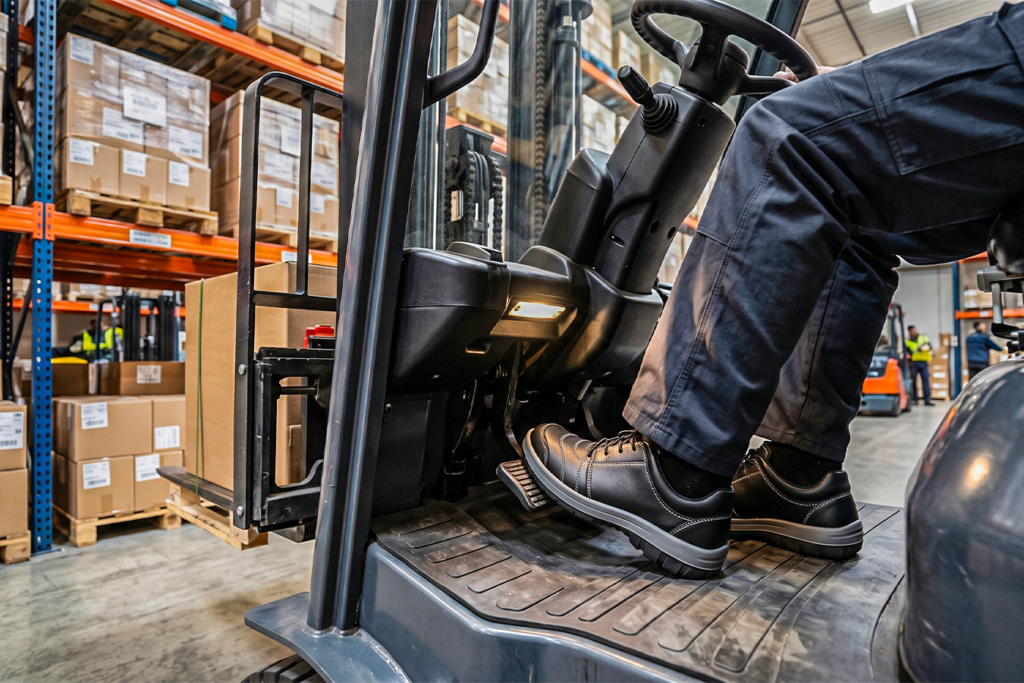
Heavy traffic from motorized equipment increases the risk of run-overs and pinching. Robust, crush-resistant footwear provides a layer of protection in this shared environment.
Refrigerated environments and climate-controlled distribution centers
Cold storage rooms and metal detectors require specific solutions, which the next section details from a technical standpoint.
Technical features of ideal safety footwear for warehouses and distribution centers
Every operational risk corresponds to a technical footwear attribute. Reading this relationship with precision is what transforms purchasing into an engineering decision rather than a price-driven choice.
Dual-density outsole and slip resistance
Wet docks and cold rooms require true grip. The dual-density outsole combines a comfort layer with a traction layer, maintaining stability even on oily or wet floors. It is the first line of defense against same-level falls.
Composite safety toe cap versus steel safety toe cap
Both protect against crushing. The composite safety toe cap has an advantage in distribution centers with metal detectors and in cold storage rooms because it does not conduct temperature and does not trigger sensors. The steel safety toe cap remains valid where cost weighs more than these factors.
Upper Height: Safety Shoe or Safety Boot?
Improving operational performance also depends on a careful analysis of the risks involved and the required level of comfort. When there is a possibility of sprains or side-foot impact hazards, the ankle safety boot is the most recommended option—such as the Lince safety boot—as it offers greater protection and stability with a higher upper.
On the other hand, in operations that present no impact hazards and require agility, lightness, and lower weight, the low-cut safety shoe becomes the most appropriate choice, ensuring mobility and comfort without compromising safety. Thus, the decision must always balance protection and performance, considering the specific characteristics of the activity.
Comfort, durability, and hygiene
Long shifts on foot call for shock absorption and an antibacterial insole with good ventilation. In daily heavy use, abrasion resistance reduces replacement frequency.
Certificate of Approval (CA)
No specification matters without a valid CA, mandatory under NR-6. Always check the CA number with the Ministry of Labor before finalizing large-scale purchases.
How to select and standardize safety footwear for the logistics team
Choosing the right model solves only part of the equation. The other part is purchasing standardized footwear for hundreds of employees without improvising, which requires aligning technical specs, budget, and legal compliance.
Map job functions and risk zones
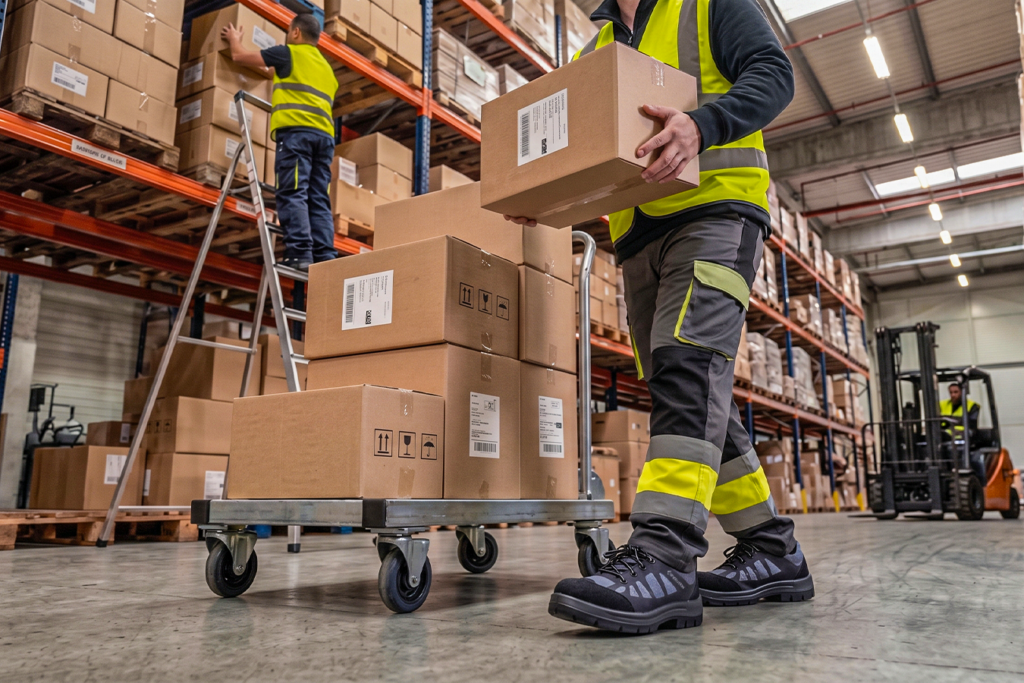
Not every workstation requires the same PPE. Separate those working in cold rooms, those moving through wet docks, and those handling pallets manually. Each zone defines priority attributes, avoiding over-purchasing or under-protecting.
Sizing and fit prevent premature replacement
Tight or loose footwear gets discarded prematurely. Size the scale with a sizing safety margin and perform actual fit testing upon onboarding. Correct fit increases compliance and reduces disposal due to discomfort.
Cost based on durability, not per unit
Experienced managers calculate total cost of ownership. An outsole with superior durability extends replacement intervals and reduces downtime for substitution, easing the distribution center's recurring budget.
Formal purchasing guarantees genuine CA certification
It is essential to choose suppliers with a solid reputation who consistently deliver a valid CA matching the purchased product, ensuring technical and regulatory compliance. Following guidelines for identifying safety footwear, a reliable origin protects both the worker and the company.
Also establish a routine for cleaning and periodic inspection, extending lifespan during intensive use.
From technical specification to continuous supply contracts
In a warehouse or distribution center, the foot is among the most exposed parts of the operation, and every risk corresponds to a specific technical attribute of the footwear.
Falling pallets call for a crush-resistant safety toe cap. Wet docks require a slip-resistant dual-density outsole. Standing shifts demand an insole with high compression resistance and comfort. It is not a matter of preference; it is safety engineering tied to NR-11 and NR-6.
Key takeaways to keep in mind: Start by cross-referencing risk with attribute: map each zone (cold room, dock, manual handling) and define PPE by profile, not by a single standard.
Also prioritize user acceptance, because uncomfortable footwear stays on the shelf, while comfort and aesthetics support daily use and lower absenteeism. Always think in terms of TCO (Total Cost of Ownership), not unit price: superior durability cuts replacement frequency—the cost that weighs heaviest in large-scale operations.
The next step is practical: build the workstation risk matrix for your operation this week and define the minimum attributes per zone. With this in hand, large-scale quoting becomes a technical discussion.
If you recognize that your logistics operation needs footwear specified by risk rather than a generic catalog, contact a Safetline specialist and request a quote for safety boots for your distribution center.
Protecting those who work is what keeps the logistics operation standing.